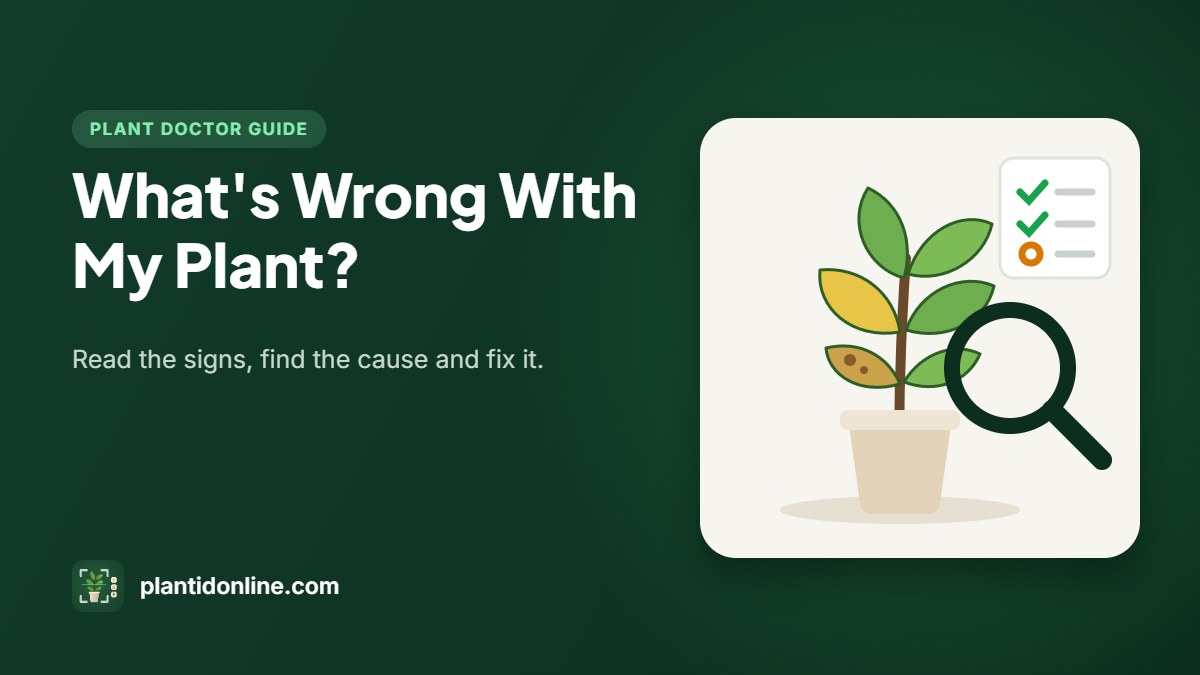
What’s Wrong With My Plant? How to Diagnose Any Plant Problem
By PlantIDOnline Editorial Team · Updated November 1, 2026
Quick answer
If you’re asking “what’s wrong with my plant?”, the answer usually comes down to water, light or roots, not disease. Check the soil first: if it’s soggy, overwatering or root rot is the likely culprit; if it’s bone-dry, the plant is thirsty. Then read the pattern — which leaves are affected (old or new), whether the whole plant or just a few spots are damaged, and whether anything changed recently. Pests and disease come after those checks, not before.
Every diagnosis starts with knowing the plant. A fern and a cactus need opposite care, so what’s “wrong” for one is normal for the other. If you’ve lost the label, identify your plant from a photo first — then work through the steps below.
What’s wrong with my plant? The 5-minute diagnosis
Plant problems look confusing because one cause can produce several symptoms, and several causes can produce the same symptom. Yellow leaves, for example, can mean too much water, too little water, too little light or a hungry plant. The way to answer “what’s wrong with my plant” is to gather clues in a fixed order, so you don’t jump to the first explanation that fits. Extension diagnosticians work the same way: collect the facts first, then match them to a cause.
- Name the plant. Know its species and what “healthy” looks like for it — some plants drop old leaves as a matter of course, others never should.
- Feel the soil about an inch (2–3 cm) down, and lift the pot. Soggy, dry or just right? Has it been wet for days?
- Find the pattern on the plant. Old lower leaves or new growth? The whole plant, one side, or scattered spots?
- Look closely at leaf undersides, leaf joints and stems for insects, webbing, sticky residue or fuzz.
- Think about recent changes. A move, repotting, a new window, a cold draught, heating switched on, fertiliser, a spray on the lawn next door?
Write the answers down. Five honest answers usually point to one or two causes — and they’re exactly what an Extension office or garden centre will ask you if you need help.
Living or non-living cause? Read the pattern
Problems fall into two groups. Non-living (abiotic) causes are growing conditions: water, light, temperature, nutrients, soil, chemicals and physical damage. Living (biotic) causes are insects, mites, fungi, bacteria, viruses and animals. Indoors, non-living causes are far more common — University of Florida plant experts call overwatering the number one way houseplants die.
|
Clue |
Points to non-living cause |
Points to living cause |
|---|---|---|
|
How the damage is spread |
Even across the plant, or on one whole side |
Starts small on one leaf or stem and spreads |
|
Several different plants affected? |
Yes — the same conditions hit them all |
Usually one plant or one type of plant |
|
How it started |
Suddenly, after a change |
Gradually, getting worse over days or weeks |
|
What you can see |
No insects, webbing, fuzz or ooze |
Insects, eggs, webbing, mould, ooze, droppings |
This isn’t a hard rule — a stressed, overwatered plant is also more likely to pick up root rot organisms — but it stops you spraying for a pest that isn’t there.
Symptom by symptom: what it usually means
Yellow leaves
If a few old, lower leaves yellow and drop while the rest of the plant looks healthy, that’s normal ageing. If many lower and inner leaves yellow and the soil is wet, suspect overwatering. Pale or yellow leaves across the whole plant with slow growth suggest a nutrient shortage; yellow leaves with green veins (interveinal chlorosis) point to iron or manganese being unavailable, often because outdoor soil pH is too high. Bleached, faded patches on the window side are sun damage.
Drooping or wilting
Drooping with dry soil is thirst, and the plant should recover within hours of a thorough watering. Drooping with wet soil is the warning sign: roots sitting in waterlogged soil suffocate and rot, and damaged roots can’t take up water, so the plant wilts even though it’s standing in water. Root rot typically starts with the bottom leaves wilting and works upward. Midday wilting in hot sun that recovers by evening is heat stress.
Brown tips and edges
Crispy brown leaf tips usually come from uneven watering, a plant that has outgrown its pot, very dry indoor air, or a build-up of fertiliser and mineral salts — look for a white crust on the soil or pot rim. Flushing the pot with plenty of water and feeding less often fixes most cases. Brown tissue won’t turn green again, so judge your fix by the new leaves.
Spots on leaves
Dry, papery spots, or dark spots with concentric rings like a target, suggest a fungal leaf spot. Dark, wet-looking, angular patches that turn mushy suggest bacteria, which is uncommon in houseplants but hard to treat. Problems that start on a single leaf and spread are more likely to be an infection; damage evenly spread over the plant is more likely to be a growing condition.
Curling or distorted leaves
Leaves that curl under or cup can be a sign of heat, dry air or underwatering. Curled, distorted new growth with sticky leaves points to aphids feeding on the tips. Outdoors, twisted, cupped new growth after someone sprayed a lawn nearby can be herbicide drift from weed killers such as 2,4-D or dicamba.
Leggy, pale or leaning growth
Long, thin stems with big gaps between leaves, small pale leaves and a plant leaning hard toward the window all mean the same thing: not enough light. Move the plant closer to a bright window, out of hot afternoon sun, and rotate it every week or two.
Leaves dropping suddenly
Sudden leaf drop is often shock from a change — a move to a darker room, a cold draught from a door, hot air from a heating vent or repotting. Fiddle-leaf figs and weeping figs are famous for it. Keep conditions stable and the plant usually settles within a few weeks.
White powder, sticky leaves or tiny insects
A white, powdery film that wipes off is likely powdery mildew. Sticky, shiny leaves mean sap-feeding insects — mealybugs, scale, aphids or whiteflies — are producing honeydew. Fine webbing and speckled leaves mean spider mites. Small black flies around wet soil are fungus gnats, a sign the mix is staying too wet.
What’s wrong with my plant? Quick reference table
|
Symptom |
Most likely cause |
First step |
|---|---|---|
|
Wilting, soil wet |
Overwatering or root rot |
Stop watering; check roots |
|
Wilting, soil dry |
Underwatering |
Water thoroughly until it drains |
|
Old lower leaves yellow, a few at a time |
Normal ageing |
Remove them; nothing else |
|
Many leaves pale or yellow |
Nutrient shortage or overwatering |
Check soil; feed lightly in the growing season |
|
Yellow leaves with green veins |
Chlorosis (pH-related) |
Soil test for outdoor plants |
|
Brown, crispy tips |
Dry soil or air, pot-bound, salts |
Flush the pot; check roots |
|
Spots with rings or papery centres |
Fungal leaf spot |
Remove leaves; keep foliage dry |
|
Leggy growth, leaning |
Too little light |
Move closer to a window |
|
Sudden leaf drop |
Shock from a change |
Keep conditions steady |
|
Sticky leaves, webbing, white fluff |
Pests |
Isolate; inspect undersides |
|
Soft, dark stem base |
Rot from wet soil |
Unpot and inspect |
Outdoor plants: extra causes to rule out
Garden plants face problems houseplants never see, and many look like disease at first glance. Michigan State University Extension’s diagnostic guide lists these common non-living causes:
- Weather: drought, waterlogging, frost, winter injury, hail and wind.
- Chemical injury: herbicide drift, de-icing salt and fertiliser burn.
- Soil and site: high or low pH, compaction, grade changes or soil piled over roots.
- Physical damage: mower and trimmer wounds, wire or rope left around a root ball, and girdling roots.
- Animals: rabbits, deer, rodents and squirrels.
If several different plants in one area decline at the same time, look first at something they share — soil, water, a chemical, or construction nearby.
A simple recovery plan
Today
Fix the obvious: water a dry plant, stop watering a wet one, move a scorched plant out of direct sun, isolate anything with pests.
Within a week
If the soil stayed wet, unpot and check the roots. Trim soft, brown roots and repot in fresh, well-draining mix.
Over the next month
Leave damaged leaves until the plant is stable, then trim them. Don’t feed a stressed plant until it’s growing again.
Judge by new growth
Old damage won’t reverse. Healthy new leaves are the sign your fix worked.
When to get expert help
Contact your local Extension office or a reputable garden centre if you still can’t work out what’s wrong with your plant, if the problem keeps spreading after you’ve fixed watering and light, if valuable trees or shrubs are declining, or if you suspect a disease that could spread to other plants. Take clear photos of the whole plant, the damaged parts and the leaf undersides, plus the answers to the five diagnosis questions above.
Chemicals last. Use a pesticide or fungicide only once the cause is confirmed, and only a product whose label lists your plant and the problem. Follow the label exactly and keep pets and children away from treated plants.
If a pet or child has chewed a plant you can’t name, call your vet or Poison Control (1-800-222-1222 in the US) straight away.
What’s wrong with my plant: FAQ
Start with the right name.
Upload a photo to the free plant identifier to find out exactly what you’re growing and what healthy looks like for it — then use this guide to fix what’s wrong.
Related guides
- Free Plant Identifier: identify any plant from a photo
- House Plant Identification: 30 Common Houseplants
- What Type of Seed Is This?
Sources
- University of Florida — Diagnosing Houseplants 101: Is Your Plant Diseased or Just Overwatered?
- Michigan State University Extension — Diagnosing Landscape Plant Problems (E-1386, archived)
- UConn Home & Garden Education Center — What’s Wrong With My Plant? Checklist
- University of Wisconsin–Madison Extension — Analyzing Reasons for Yellow Leaves
- Iowa State University Extension — Root Rots of Houseplants
- Iowa State University Extension — Diagnosing Houseplant Problems Caused by Insect Pests